


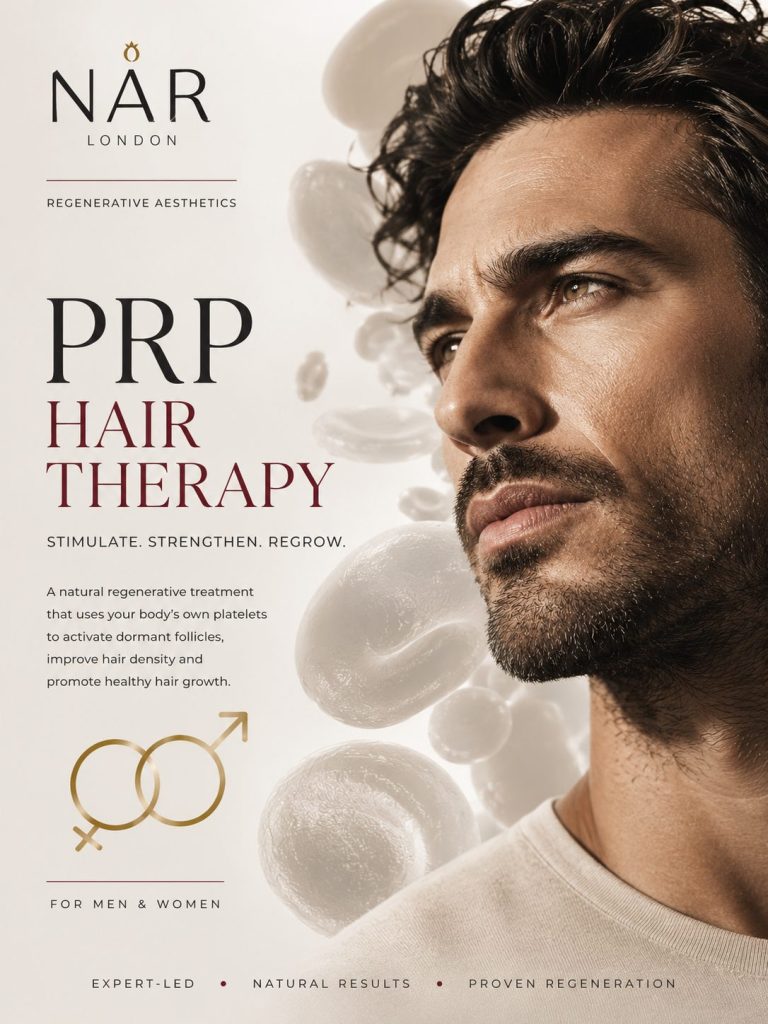
PRP Hair Loss Treatment for Men and Women
Autologous platelet-rich plasma treatment for men and women experiencing hair thinning and pattern hair loss, at NAR LONDON on Harley Street.
PRP (Platelet-Rich Plasma) hair treatment is an autologous, non-surgical treatment for selected men and women experiencing hair thinning and pattern hair loss.
At NAR LONDON on Harley Street, PRP is prepared from a small sample of your own blood and injected into targeted areas of the scalp. Platelets release growth factors involved in tissue repair and cell signalling, which may support hair follicle activity and improve hair density and thickness in suitable patients.
PRP does not create new hair follicles and cannot restore hair where follicles are no longer viable. It can, however, stimulate “dormant” hair follicles to grow. Results vary according to the cause, severity and duration of hair loss, which is why appropriate assessment and patient selection are important.
What is PRP Treatment for Hair Loss?
Platelet-rich plasma (PRP) treatment is an established non-surgical method for hair restoration, suitable for both men and women experiencing hair loss. This innovative therapy utilises the patient’s own blood, making it an autologous treatment that promotes natural healing and growth.
How PRP Treatment Works?
The PRP process begins with a small blood draw. The collected blood is processed using a centrifuge to separate and concentrate the platelet-containing plasma.
Platelets contain and release growth factors and signalling proteins involved in tissue repair and cellular activity. Once prepared, the PRP is carefully injected into targeted areas of the scalp. Research suggests that PRP may support follicular activity and improve hair density and thickness in suitable patients.
Comfort During the Procedure
For patients concerned about discomfort during the injections, we use the U225 mesogun to minimise any potential pain associated with the PRP treatment.
Treatment Timeline & Maintenance
The entire PRP treatment process, from blood draw to injection, typically takes around 40-60 minutes. Downtime is generally minimal, although temporary scalp tenderness, redness or swelling may occur.
An initial course of PRP treatments is commonly recommended, typically consisting of 3-6 sessions spaced approximately 4–6 weeks apart. Maintenance treatment may subsequently be recommended according to individual response and progression of hair loss.
BOOK YOUR CONSULTATION
Benefits of PRP for hair
Clinical studies suggest that PRP may improve hair density and hair thickness in selected patients, particularly those with androgenetic alopecia.
Potential benefits include:
- Supporting existing hair follicles
- Improving hair density and thickness in suitable patients
- Supporting the hair-growth environment
- A non-surgical approach
- Autologous treatment using the patient’s own blood
- Minimal interruption to normal activities
Results vary, and PRP cannot regenerate follicles that are no longer viable.
PRP + Mesotherapy
For selected patients, PRP may be combined with hair mesotherapy as part of a personalised treatment programme. Mesotherapy involves targeted microinjections of selected ingredients into the scalp. Whether PRP alone or a combined approach is appropriate depends on the patient’s pattern of hair loss, scalp condition and individual treatment plan.
The combination of PRP and Mesotherapy could help strengthen, nurture and energise hair follicles.
PRP + Salmon Exosomes
The combination of Platelet-Rich Plasma (PRP) and salmon exosomes for hair restoration represents an innovative and promising approach that harnesses the regenerative benefits of both therapies. PRP uses the patient’s own blood to provide essential growth factors, while salmon exosomes present a non-injectable delivery system rich in bioactive molecules. Together, these treatments can significantly help enhance hair growth, stimulate the regeneration of hair follicles, and promote overall scalp health.
Get PRP Hair in London
Take the first step towards restoring your hair. If you’re looking for a safe and effective solution for hair loss, consider Autologous Platelet-Rich Plasma (PRP) therapy. With our expertise, you can embark on a personalised journey toward thicker, healthier hair.
Book your PRP hair loss treatment or schedule a consultation today to discover how PRP can help you regain your confidence and combat hair loss effectively and help you achieve fuller, healthier hair.
Downtime: Minimal – temporary tenderness, redness or swelling may occur
Treatment Time: 60 mins
How often: 4 – 6 weeks intervals
Recommendation: 3 to 6 sessions + 1 or 2 maintenance session(s) per year
PRP HAIR LOSS TREATMENT PRICE
1 session
£475
3 session
£1350
6 session
£2590
PRP + MESOTHERAPY PRICE
1 session
£595
3 session
£1675
6 session
£2990
PRP + EXOSOMES PRICE
1 session
£900
3 session
£2550
6 session
£4800

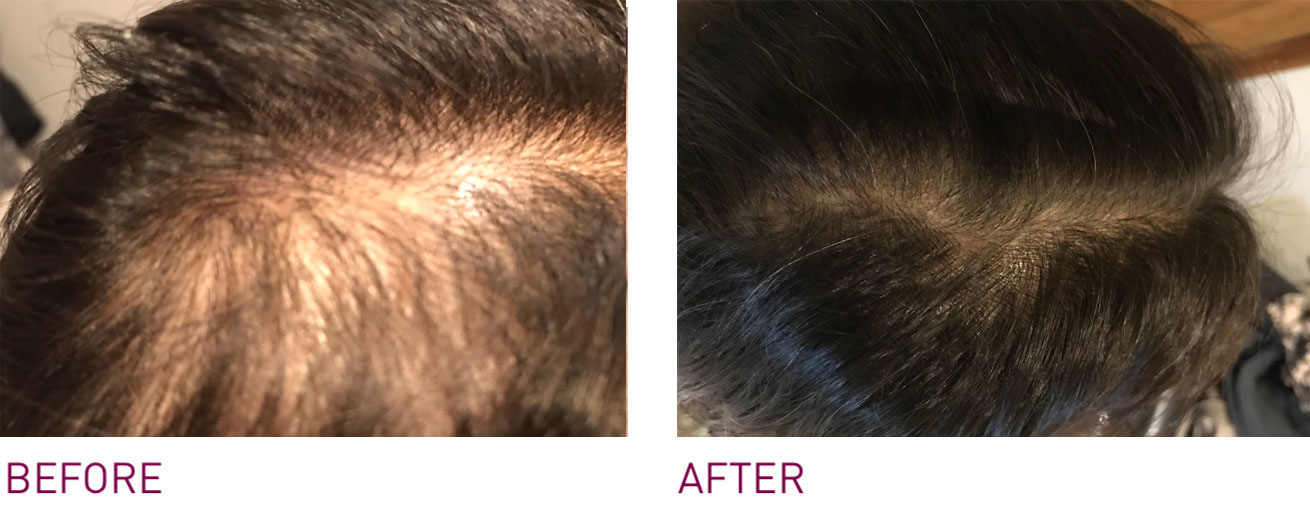
PRP BEFORE & AFTER
FAQ’s about PRP Hair
Does PRP work for Hair Loss ?
Clinical studies suggest that Platelet-Rich Plasma (PRP) can improve hair density and hair thickness in some patients, particularly those with androgenetic alopecia (male and female pattern hair loss).
PRP appears to be most useful when hair follicles are still present but have become thinner or less active. Results vary between individuals and depend on factors including the cause and stage of hair loss, age, individual biology and the treatment protocol used.
PRP cannot create new hair follicles or restore hair in areas where follicles are no longer viable.
What types of hair loss can PRP help?
PRP is most commonly used for androgenetic alopecia, also known as male or female pattern hair loss. It may also be considered for selected patients experiencing reduced hair density, progressive thinning or as part of a hair-restoration programme before or after a hair transplant.
Sudden, unexplained or extensive hair shedding should be appropriately assessed before treatment, as nutritional deficiencies, hormonal changes, thyroid conditions, medications, stress, autoimmune conditions and other health factors can contribute to hair loss.
How Does PRP Hair Treatment Work?
PRP treatment begins with a small sample of your own blood. The blood is processed using a centrifuge to separate and concentrate the platelet-containing plasma.
Platelets contain and release growth factors and signalling proteins involved in tissue repair and cellular activity. The prepared PRP is then carefully injected into targeted areas of the scalp.
Research suggests that PRP may support follicular activity and improve hair density and thickness in suitable patients.
How Many PRP Hair Treatments Will I Need?
A course of treatment is usually recommended rather than a single PRP session.
At NAR LONDON, the number and timing of treatments are personalised according to your pattern of hair loss, scalp condition, previous treatments and response to PRP.
Maintenance sessions may subsequently be recommended to help support results.
When Will I See Results From PRP Hair Treatment?
PRP is not an instant hair-loss treatment. Changes occur gradually because hair grows in cycles. Some patients begin noticing reduced shedding or changes in hair quality during the first few months, while improvements in density and thickness generally require more time to become apparent. Results and timelines vary considerably between individuals.
How Long Do PRP Hair Results Last?
There is no fixed duration that applies to every patient. Hair loss conditions such as androgenetic alopecia are progressive, so PRP does not permanently stop the underlying ageing or genetic process. Following an initial course, periodic maintenance treatments may be recommended according to your response, pattern of hair loss and treatment objectives.
Is PRP Better for Early Hair Loss?
Generally, PRP has greater potential when viable hair follicles are still present. For this reason, patients experiencing early or moderate thinning may be better candidates than patients with longstanding areas of complete hair loss. An assessment helps determine whether PRP is likely to be appropriate before beginning treatment.
Can PRP Regrow Hair on a Completely Bald Area?
PRP cannot create new hair follicles. If follicles are no longer viable, PRP is unlikely to restore significant hair growth in that area. In cases of advanced hair loss, hair transplantation or another treatment strategy may be more appropriate. This is why realistic assessment and patient selection are important.
Is PRP Hair Treatment Suitable for Women?
Yes. PRP may be considered for both men and women experiencing suitable forms of hair thinning, including female pattern hair loss. Hair loss in women can have several contributing factors, however, including iron deficiency, hormonal changes, thyroid dysfunction and nutritional factors. Where appropriate, further investigation may therefore be recommended before or alongside scalp treatment.
Should the Cause of My Hair Loss Be Investigated Before PRP?
Sometimes. Not every case of hair loss originates solely from the scalp. Iron status, thyroid function, nutritional deficiencies, hormonal changes, stress, medications and other medical factors can contribute to excessive shedding or thinning.
At NAR LONDON, we may recommend further investigation or referral when the pattern or history of hair loss suggests an underlying factor should be explored. Treating the scalp without considering the underlying cause is not always the most appropriate approach.
Is PRP Hair Treatment Painful?
PRP involves multiple small injections into the scalp, so some discomfort can be expected when applied manually. Sensitivity varies between individuals. Measures can be taken to make the procedure more comfortable, and your practitioner will explain what to expect before treatment. The scalp may remain temporarily tender following the procedure.
That said, we use the special injector U225 that makes the experience almost painless.
Is There Any Downtime After PRP Hair Treatment?
Downtime is generally minimal. Temporary redness, tenderness, mild swelling or sensitivity at the injection sites can occur following treatment. These effects usually settle without significant interruption to normal activities. Your practitioner will provide appropriate aftercare instructions following your appointment.
Is PRP Hair Treatment Safe?
PRP is an autologous treatment, meaning the platelet-rich plasma used during the procedure is prepared from your own blood. This reduces the possibility of an allergic reaction to the PRP material itself. As with any injectable procedure, temporary discomfort, bruising, redness, swelling or tenderness can occur. PRP is not appropriate for everyone, and your medical history and suitability should be assessed before treatment.
Who Should Not Have PRP Hair Treatment?
Suitability depends on your medical history, the cause of your hair loss and your individual health. Certain blood or platelet disorders, active infection and some medical conditions or medications may make PRP inappropriate or require additional assessment.
Hair loss associated with an untreated underlying medical or nutritional condition should also be appropriately investigated and managed. Your practitioner will review relevant contraindications before treatment.
What Should I Avoid Before PRP Hair Treatment?
Before your appointment, follow the specific instructions provided by your practitioner. You should arrive well hydrated and inform us about any medication, supplements or medical conditions. Do not stop prescribed medication, including blood-thinning medication, unless the clinician responsible for prescribing it has specifically advised you to do so.
What Should I Avoid After PRP Hair Treatment?
Following PRP, you may be advised to avoid washing or applying products to the scalp for a short period and to temporarily avoid strenuous exercise, excessive heat, saunas, steam rooms or activities that could irritate the treated area. Your practitioner will give you specific aftercare instructions based on your treatment.
Can PRP Be Combined With Other Hair-Loss Treatments?
Yes. Depending on the cause of hair loss and the patient’s treatment plan, PRP may form part of a broader hair-restoration programme.
At NAR LONDON, regenerative options include PRF, Exosomes and other targeted scalp treatments. In selected patients, PRP may also be combined or sequenced with treatments such as scalp microneedling or mesotherapy.
Combination treatment is not automatically better for every patient. The appropriate approach depends on the type and stage of hair loss and should be selected following assessment.
What Is the Difference Between PRP and PRF for Hair Loss?
Both PRP and PRF are autologous treatments prepared from the patient’s own blood, but they are processed differently and have different biological characteristics.
PRP produces a platelet-rich plasma preparation, while PRF creates a fibrin-rich preparation designed to retain platelets and naturally occurring signalling components within a fibrin matrix.
NAR LONDON offers both PRP and PRF hair treatments. The most appropriate option can be discussed during your consultation.
Is PRP Better Than a Hair Transplant?
PRP and hair transplantation have different purposes. PRP aims to support existing viable hair follicles. A hair transplant physically relocates viable follicles from a donor area to areas affected by hair loss. PRP cannot replace follicles that have permanently disappeared and therefore should not be presented as an alternative to transplantation in every patient. PRP may, however, form part of a wider hair-restoration programme for suitable patients, including around hair-transplant treatment where clinically appropriate.
How Much Does PRP Hair Treatment Cost in London?
At NAR LONDON, current PRP hair treatment prices are displayed on this page and confirmed when booking. Courses are available for patients who require multiple sessions, and your practitioner can recommend the appropriate treatment programme following assessment.
Where Is PRP Hair Treatment Performed at NAR LONDON?
PRP hair treatments are performed at NAR LONDON, 15 Harley Street, London W1G 9QQ. Our approach combines regenerative scalp treatment with personalised assessment, and where appropriate we may also consider potential underlying factors contributing to hair loss.
Why Choose NAR LONDON for PRP?
NAR LONDON is an independent regenerative aesthetics and integrative health clinic at 15 Harley Street, London W1G 9QQ. Hair-loss treatments are performed by Esra Gulsen, founder and practitioner at NAR LONDON, with more than 10 years’ experience in hair-loss and regenerative treatments.
Our approach includes:
- Personalised assessment before treatment
- More than 10 years’ experience in hair-loss treatments
- Continuity of care with the same practitioner
- PRP, PRF, autologous exosomes and other regenerative options
- Investigation of underlying health factors where appropriate
- Clear discussion of what treatment can – and cannot – realistically achieve
Hair Loss Is Not Always Just a Scalp Problem
Hair loss is not always caused by the hair follicle alone. Depending on the patient’s history and pattern of hair loss, factors such as iron status, thyroid function, nutritional deficiencies, hormonal changes, stress and other health conditions may need to be considered. At NAR LONDON, our approach can extend beyond scalp treatment. Where appropriate, we may recommend further investigation or referral rather than proceeding directly with PRP. This is particularly important for patients experiencing sudden or unexplained shedding.
Where Can I Have PRP Hair Treatment in London?
Visit NAR LONDON on Harley Street for expert PRP hair loss treatment. Book online or schedule a consultation today.