


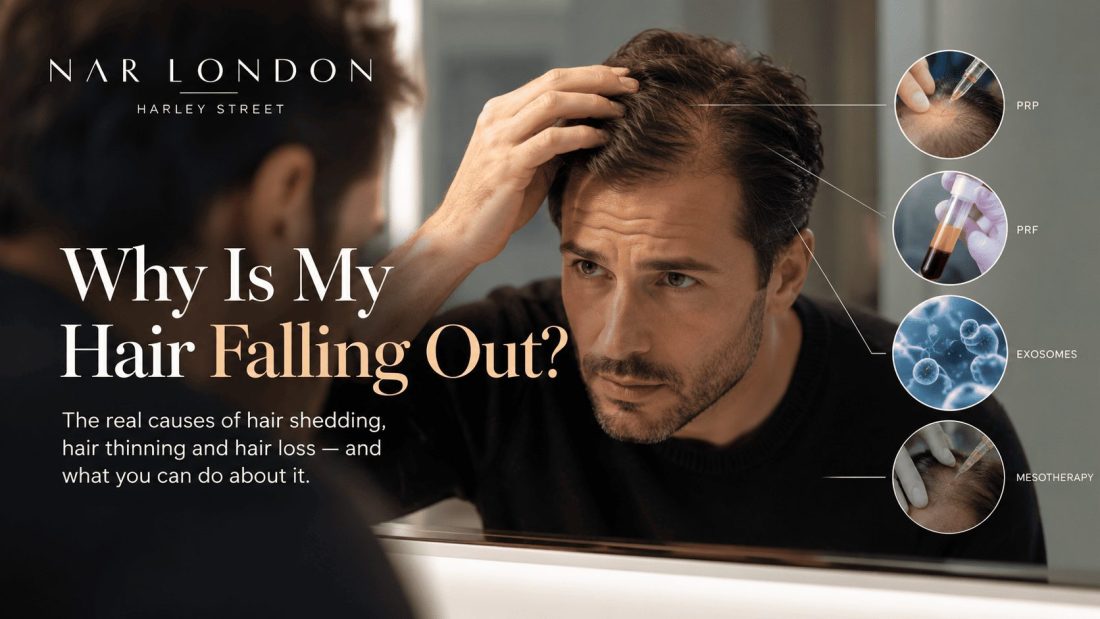
Why my hair is falling out?
Why Is My Hair Falling Out? Understanding Hair Shedding, Thinning and Hair Loss
You probably noticed it in a fairly ordinary moment.
A few more hairs than usual around the plughole. More strands on your pillow. Your hairbrush looking suspiciously full. Perhaps you ran your fingers through your hair and came away with more hair than you expected.
So you started looking.
You checked your parting in the mirror. Compared your ponytail with an older photograph. Maybe you even started counting the hairs in the shower.
And then, inevitably, you searched:
Why is my hair falling out?
It is a simple question, but there isn’t one simple answer.
Sometimes increased shedding is temporary and follows something that happened to your body several weeks or months earlier. Sometimes the issue is nutritional, hormonal or thyroid-related. Sometimes the hair is gradually becoming finer because of hereditary hair loss. And occasionally, hair loss is a sign of a scalp or medical condition that needs proper assessment.
There can also be more than one thing happening at the same time.
At NAR LONDON, we therefore don’t start with the question, “Which hair treatment should you have?”
We start with:
What has changed, and why?
That distinction matters.
Because if you understand the reason your hair is falling out, you are in a much better position to decide what to do about it.
First, Don’t Panic About the Hairs in Your Brush
It is completely normal to shed hair.
Hair follicles are constantly moving through their own growth cycle. Some are actively growing, some are resting, and some are reaching the end of their cycle and releasing an old hair.
The American Academy of Dermatology estimates that people normally shed around 50 to 100 hairs a day. The British Association of Dermatologists gives a broader estimate of around 30 to 150 hairs a day.
That sounds like a lot until you remember that you have thousands of hair follicles on your scalp.
So seeing hair in your shower is not, by itself, evidence that something is wrong.
What matters more is change.
Has your hair suddenly started shedding much more than it used to?
Does your ponytail feel smaller?
Has your parting become wider?
Are you seeing more scalp?
Is your hairline changing?
Are you developing a patch where there wasn’t one before?
Those observations tell us much more than trying to count every strand.
Hair Shedding and Hair Loss Are Not Quite the Same Thing
This is one of the first distinctions worth making.
Hair shedding means that hairs are being released from the scalp as part of the hair cycle. If considerably more hairs than usual enter the shedding phase, this is often called telogen effluvium.
Hair loss is a broader term. It can describe a situation where hair growth is reduced, follicles progressively produce thinner hair, or hair stops growing altogether.
The two can look similar when you’re standing over the shower drain.
But biologically, they can be very different.
And yes, a person can have both.
For example, someone with early hereditary hair thinning may go through a period of excessive shedding after an illness. The temporary shedding can make the underlying thinning much more noticeable.
That is why the answer isn’t always simply, “It’s stress,” or, “It’s just seasonal.”
The pattern matters. The timing matters. Your health history matters.
Your Hair Has a Memory
This is perhaps the most useful thing to understand about sudden hair shedding.
Your hair doesn’t always react immediately to what your body has been through.
The hair cycle is slow.
A significant physical or emotional event can disrupt the cycle, but you may not notice the resulting shedding until weeks or months afterwards.
This is particularly relevant to telogen effluvium, a common form of excessive hair shedding.
So if someone comes to us saying:
“My hair has suddenly started falling out. Nothing has happened recently.”
one of the most useful questions is actually:
What happened three months ago?
Think back.
Were you ill?
Did you have a high fever?
Have surgery?
Go through an unusually stressful period?
Lose a significant amount of weight?
Start a restrictive diet?
Give birth?
Change hormonal medication?
Stop taking the contraceptive pill?
Sometimes the event that triggered the shedding is already behind you by the time you notice the hair loss.
So, What Actually Causes Hair to Fall Out?
There are many possibilities.
Rather than putting every possible cause into one long medical list, it is more useful to think about the kinds of changes that can affect your hair.
Your Body Has Been Through Something
Illness, high fever, surgery, childbirth, significant weight loss and major stress can all be followed by increased shedding.
This is the classic territory of telogen effluvium.
It can be frightening because the shedding may be dramatic. You can feel as though your hair is coming out everywhere — in the shower, on your clothes, on your pillow and on your brush.
The reassuring part is that this type of shedding is often temporary.
Once the trigger has passed and the hair cycle settles, shedding generally reduces and fullness can gradually return.
But “temporary” doesn’t mean you should automatically assume that’s what you have.
That is where assessment becomes useful.
Stress and Hair Loss: Is There Really a Connection?
Yes, significant stress can affect the hair cycle.
But it is worth being precise about what that means.
We all experience stressful days. A difficult week at work does not automatically mean your hair is going to fall out.
The type of stress associated with telogen effluvium is often more substantial — major psychological stress, significant illness, surgery, childbirth or another physiological shock.
And, frustratingly, the hair may not respond straight away.
This delayed response is one reason people often miss the connection.
Could Your Diet Be Part of the Problem?
Hair is not essential for survival.
Your body knows this.
When energy or nutrients are severely restricted, the body prioritises essential functions. Hair growth can become less of a priority.
Significant weight loss and restrictive dieting can trigger excessive shedding.
Nutritional deficiencies can also contribute to hair problems in some people.
Iron is one of the things practitioners may consider when investigating unexplained shedding, alongside other nutritional and health factors where appropriate.
But this is where we would urge a little caution.
It is very easy to see a hair supplement advertised online and think:
“Perhaps I’m deficient in everything.”
Usually, the better question is:
“Is there actually a deficiency or health issue that needs addressing?”
Taking more supplements isn’t automatically better.
What About Thyroid Problems?
Your thyroid influences many processes throughout the body, and thyroid disorders can be associated with changes in hair growth and shedding.
If hair loss occurs alongside other symptoms, or there is a reason to suspect thyroid dysfunction, thyroid testing may form part of a broader investigation.
Again, it is not about assuming that your thyroid is the cause.
It is about considering the possibilities rather than treating the hair in isolation.
Hormones Can Change Your Hair Too
Pregnancy, the postpartum period, perimenopause, menopause and other hormonal changes can all coincide with noticeable changes in hair.
Some women notice significant shedding a few months after giving birth.
Other hormonal changes can affect hair in different ways.
This is particularly important because hormonal changes and hereditary hair loss can overlap.
A woman may experience a period of excessive shedding and, at the same time, have an underlying tendency towards female pattern hair loss.
So “it’s hormonal” isn’t really a diagnosis.
It is the beginning of a question.
Is Your Hair Actually Getting Thinner Rather Than Simply Shedding?
This is an important distinction.
Some people notice handfuls of hair coming out.
Others don’t see much extra shedding at all. Instead, they slowly realise that their hair doesn’t have the same volume it once did.
The parting looks wider.
The ponytail feels smaller.
The crown is more visible.
The hairline seems to have changed.
These can be signs of pattern hair loss, which is one of the most common forms of hair loss in both men and women.
In women, a widening part or gradual reduction in overall density can be an early sign.
In men, a receding hairline or thinning crown is common.
Unlike a temporary episode of shedding, hereditary hair loss can be progressive because susceptible follicles gradually become smaller.
That is one reason early assessment can be useful.
Look at the Pattern, Not Just the Hairbrush
If you’re worried about your hair, take a step back from the shower drain and look at where the change is happening.
Hair coming out fairly evenly across the scalp
This can be seen with diffuse shedding, including telogen effluvium.
A widening central part
This can be an early sign of female pattern hair loss.
Receding temples or hairline
This can occur with male pattern hair loss, although other causes are possible.
A thinning crown
This is another common pattern of androgenetic hair loss.
A smooth, round patch
This can occur with alopecia areata and deserves assessment rather than being assumed to be ordinary shedding.
Itching, redness, scaling, pain or inflammation
This suggests that the scalp itself may need attention.
Lots of shorter, broken hairs
This may be breakage rather than hair shedding from the follicle.
The pattern gives us information.
Sometimes the Problem Isn’t the Follicle. It’s the Hair Itself.
Hair can break.
Bleaching, chemical processing, frequent heat styling and rough handling can weaken the hair shaft. Tight hairstyles and extensions can also place repeated tension on follicles and, over time, contribute to traction alopecia.
So if you are seeing lots of short pieces of hair rather than full-length shed hairs, the answer may be very different.
This is another reason not to diagnose the cause from the amount of hair in your brush alone.
And Then There Is the Scalp
Your hair grows from your scalp.
It sounds obvious, but it is surprisingly easy to forget.
If the scalp is inflamed, irritated or affected by a dermatological condition, the follicles may be affected too.
Persistent itching, redness, scaling, tenderness, crusting or clearly defined areas of hair loss should not simply be written off as “normal shedding”.
Some forms of hair loss, including alopecia areata and scarring alopecias, need specific assessment.
If you have a sudden bald patch or noticeable scalp changes, it is worth getting it looked at rather than waiting to see whether it disappears.
Why Does My Hair Fall Out More in Autumn?
If you are reading this because you have suddenly noticed more hair in October or November, there may be a perfectly reasonable explanation — but don’t assume the season is the whole story.
Hair growth does have seasonal variation, and some people notice more shedding at certain times of year.
But autumn also happens to be a time when people may be noticing the delayed effects of things that happened during summer.
Perhaps you were ill.
Perhaps you travelled, slept badly, lost weight, changed your diet or went through a stressful period.
Perhaps you spent a lot of time in the sun and heat.
Or perhaps there is an underlying pattern of hair thinning that has simply become more noticeable.
So yes, seasonal shedding may be part of the picture, but persistent or pronounced shedding should not automatically be attributed to the season.
If this is exactly what you’re experiencing, read our guide:
Why Are You Losing So Much Hair in October and November?
Should You Have Blood Tests for Hair Loss?
Sometimes. Not always.
There is no single blood test that can tell you why everyone’s hair is falling out.
The useful tests depend on the person sitting in front of you.
If your shedding is persistent or unexplained, your history might lead a practitioner to consider areas such as:
iron status · thyroid function · hormones · nutritional markers · inflammation · blood count
Other tests may be appropriate depending on your symptoms and medical history.
At NAR LONDON, we offer dedicated Hair Loss Blood Testing to investigate possible contributors to thinning hair and hair loss, including markers relating to hormones, thyroid health and iron status. An Advanced Hair Loss Blood Test is also available where appropriate.
The important part is not ordering as many tests as possible.
It is asking the right questions first.
Before You Buy Another Hair Supplement…
This is worth saying because the internet makes it very easy to spend a small fortune trying to fix hair loss.
Biotin gummies.
Hair vitamins.
Scalp oils.
“Detox” programmes.
Shampoos promising thicker hair.
Some products may improve the appearance or condition of the hair. Some supplements are appropriate when a genuine deficiency exists.
But none of these answers the fundamental question:
Why are you losing your hair?
If you are iron deficient, that needs to be understood.
If your thyroid is abnormal, that needs to be addressed.
If you have telogen effluvium after an illness, the priority may be supporting recovery and allowing the hair cycle to normalise.
If you have hereditary hair loss, the strategy is different again.
The treatment should follow the cause.
When Should You Actually Do Something About Hair Loss?
If you’ve noticed a change, you don’t need to panic.
But you don’t need to ignore it either.
It is worth having your hair loss assessed if:
- shedding has suddenly become much heavier than usual
- it continues rather than settling
- your hair density is visibly decreasing
- your parting is becoming wider
- your hairline is receding
- you have developed a bald patch
- your scalp is painful, itchy, inflamed or unusually flaky
- you’ve recently experienced significant illness or weight loss
- you’ve noticed other symptoms alongside the hair loss
- you’re simply concerned that something has changed
The earlier you understand what is happening, the more informed your treatment options can be.
What Can Actually Be Done About Hair Loss?
This is where things become much more individual.
There isn’t one treatment that works for every type of hair loss.
For some people, the answer is primarily to identify and address the trigger.
For others, established medical treatments may be appropriate.
For some patients with pattern hair loss or thinning, regenerative treatments can form part of a wider treatment plan.
And sometimes more than one approach makes sense.
At NAR LONDON, we offer regenerative hair treatments including PRP Hair Treatment in London, PRF Hair Treatment in London, Autologous Exosomes for Hair and Hair Mesotherapy, with FUE hair-transplant collaboration available where appropriate.
The important word is appropriate.
PRP for Hair Loss
Platelet-Rich Plasma, or PRP, is an autologous treatment made using a patient’s own blood.
A small blood sample is processed to concentrate platelets and plasma before the preparation is injected into selected areas of the scalp.
PRP has been studied particularly in androgenetic hair loss, although response varies and it is not a treatment for every cause of hair loss.
At NAR LONDON, PRP is offered as part of a personalised approach to hair thinning and loss.
Explore PRP Hair Treatment in London
PRF for Hair Loss
Platelet-Rich Fibrin (PRF) is another autologous platelet-based treatment.
Like PRP, it uses your own blood. The preparation and composition are different, including the formation of a fibrin matrix.
PRF is used at NAR LONDON as one of the regenerative options we may consider for selected patients with hair thinning.
It is not useful to say that one treatment is automatically “better” for everyone.
The more useful question is:
Which treatment makes sense for this particular type of hair loss?
Explore PRF Hair Treatment in London
What About Exosomes for Hair Loss?
This is an area of considerable interest in regenerative medicine, but it is also an area where we think it is important to be honest about the evidence.
Exosomes and other extracellular vesicles are involved in cell-to-cell communication, and research is investigating their potential role in tissue repair and hair follicle biology.
The field is still developing.
At NAR LONDON, we offer Autologous Exosome Hair Treatment as a regenerative option for selected patients. We do not present it as a guaranteed cure or as the right answer for every type of hair loss.
That distinction matters when you are considering an emerging treatment.
Hair Mesotherapy
Hair mesotherapy uses small injections to deliver a selected formulation into the scalp.
At NAR LONDON, Hair Mesotherapy may be considered for people experiencing early thinning, diffuse shedding and other selected hair concerns, depending on their individual assessment.
It can also be combined with other regenerative treatments in some personalised protocols.
Again, the aim is not to treat every person in exactly the same way.
There Isn’t a “Best” Hair-Loss Treatment for Everyone
This is probably the most important part of the whole article.
You may see:
PRP vs PRF
PRF vs exosomes
Exosomes vs mesotherapy
The best treatment for hair growth
all over the internet.
But those comparisons only make sense once you know what is actually causing the hair loss.
Someone with temporary telogen effluvium after illness is not the same as someone with progressive androgenetic alopecia.
Someone with a nutritional deficiency is not the same as someone with traction alopecia.
And someone with an inflammatory or autoimmune scalp condition may need an entirely different medical approach.
So rather than asking:
“What is the best treatment for hair loss?”
a better first question is:
“What type of hair loss do I have?”
Then you can ask what treatments are appropriate for that particular situation.
How We Approach Hair Loss at NAR LONDON
At NAR LONDON, we see hair loss as more than a cosmetic issue.
Hair is affected by what is happening at the follicle, but also by the wider environment in which that follicle is growing.
That can include health, nutrition, hormones, inflammation, stress, genetics and the scalp itself.
Our approach is therefore to look at the individual rather than start with a treatment menu.
Depending on your circumstances, this may involve:
Understanding your history
↓
Looking at the pattern of shedding or thinning
↓
Considering possible underlying factors
↓
Investigating where appropriate
↓
Discussing realistic treatment options
↓
Building a personalised plan
That might involve PRP, PRF, hair mesotherapy, autologous exosomes or another approach – or it may mean addressing an underlying issue first.
Sometimes the most useful thing we can tell someone is that they don’t need an injection.
That is part of good hair-loss care too.
The Question Isn’t Really “Why Is My Hair Falling Out?”
It’s a little more complicated than that.
The better questions are:
When did it start?
What changed?
What happened a few months before it started?
Where is the hair changing?
Is it shedding, thinning or breaking?
Is the scalp healthy?
Could there be an underlying nutritional, hormonal or medical factor?
And only then:
What treatment, if any, is appropriate?
Hair is slow.
That can be frustrating when you’re watching it disappear down the shower drain, but it also means there is often more information in the story than you realise.
You don’t have to diagnose yourself from a handful of hair.
And you don’t have to wait until the thinning becomes obvious to everyone else before asking for help.
Start by understanding what has changed.
That is usually the most useful first step.
Frequently Asked Questions About Hair Loss
Why is my hair suddenly falling out?
Sudden increased shedding can have several causes, including telogen effluvium following illness, significant stress, weight loss, surgery, childbirth or other physiological changes. The trigger may have occurred weeks or months before the shedding becomes obvious.
How much hair is normal to lose each day?
There is no practical need to count every hair, but normal daily shedding is often estimated at around 50–100 hairs. What matters more than counting is whether your normal pattern has changed.
Why am I losing more hair in the shower?
Washing can make normal shedding look more dramatic because hairs that have already reached the end of their cycle are released together. If you are consistently seeing much more hair than usual, however, or noticing visible thinning, it is worth investigating.
Can stress cause hair loss?
Significant psychological or physical stress can trigger telogen effluvium, a form of excessive shedding. The effect may not become noticeable until months after the stressful event.
Can illness cause hair loss months later?
Yes. Illness, particularly illness accompanied by high fever, can disrupt the hair cycle. Increased shedding may become noticeable several months after recovery.
Can weight loss cause hair shedding?
Significant weight loss and restrictive dieting can trigger telogen effluvium. If shedding began after a period of rapid weight loss, the timing is worth discussing with a healthcare professional.
Can low iron cause hair loss?
Iron status can be relevant in the investigation of some cases of hair shedding. It is not, however, the cause of every case of hair loss, which is why testing should be guided by the individual’s history and symptoms.
Can thyroid problems cause hair loss?
Yes. Thyroid disorders can be associated with changes in hair growth and shedding. If there is a clinical reason to suspect thyroid dysfunction, thyroid testing may form part of an appropriate investigation.
Why is my hair thinning but I don’t notice lots of shedding?
Some forms of hair loss are gradual. In pattern hair loss, follicles can progressively produce finer hairs, resulting in a reduction in density without dramatic shedding. A widening part, thinner ponytail, receding hairline or increasing scalp visibility can be early signs.
Is autumn hair shedding real?
Hair growth has seasonal variation, and some people notice more shedding at particular times of year. However, persistent or pronounced shedding should not automatically be attributed to the season. Other factors, including illness, stress, weight changes and hormonal changes, may be involved.
Should I have blood tests for hair loss?
Not everyone with hair loss needs blood testing. Where there is persistent or unexplained shedding, testing may be considered based on the individual’s symptoms and history. Possible areas of investigation can include iron status, thyroid function, hormones and nutritional or inflammatory markers.
Can PRP help with hair loss?
PRP has been studied for certain forms of hair loss, particularly androgenetic alopecia. It may be considered for selected patients, but results vary and it is not appropriate for every cause of hair loss.
Is PRF better than PRP for hair loss?
PRF and PRP are different autologous platelet-based preparations. There is not a single treatment that is best for every patient. Suitability depends on the type and stage of hair loss, the individual’s history and their treatment goals.
Can exosomes help with hair loss?
Exosome and extracellular-vesicle approaches are an emerging area of regenerative research. Research is investigating their potential role in hair biology, but the evidence is still developing. They should not be presented as a guaranteed cure for hair loss.
Can hair loss grow back?
Sometimes. Temporary shedding caused by a reversible trigger can recover once the underlying problem settles. Other forms of hair loss, particularly progressive hereditary hair loss, may require ongoing treatment to preserve or improve density. The outlook depends on the cause, how advanced the hair loss is and how early it is addressed.
Hair Loss Is a Symptom. Start There.
If your hair has suddenly changed, it is understandable to want an immediate solution.
But the most useful first step is rarely to throw everything at it.
Look at the pattern. Look at the timing. Look at what was happening in your health and your life before the shedding began.
Then decide what needs to happen next.
At NAR LONDON on Harley Street, our approach combines hair and scalp assessment with consideration of the wider factors that may be relevant to an individual’s hair loss. Where appropriate, we offer regenerative treatments including PRP, PRF, hair mesotherapy and autologous exosomes, alongside hair-loss blood testing and FUE hair-transplant collaboration.
Because treating hair loss well isn’t about finding the treatment with the most impressive name.
It’s about understanding the hair in front of you.
NAR LONDON
Harley Street Regenerative Aesthetics Clinic
15 Harley Street
London W1G 9QQ
Hair Loss Consultations · PRP · PRF · Autologous Exosomes · Hair Mesotherapy · Hair Loss Blood Testing