


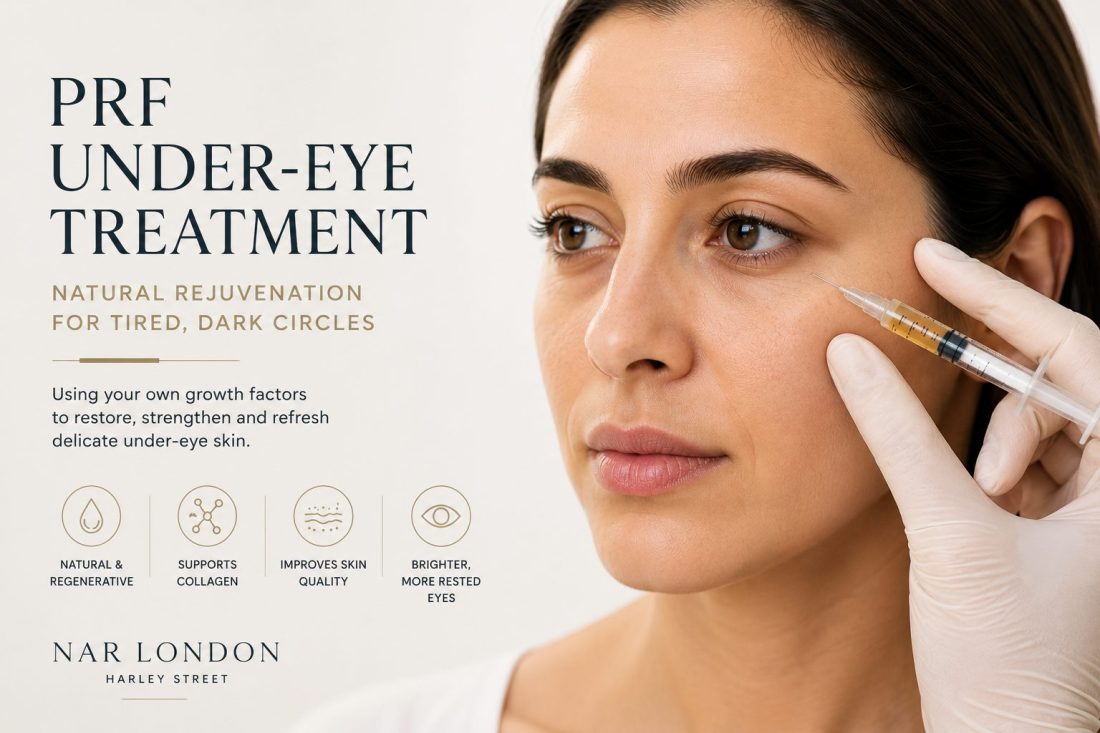
What is PRF Treatment?
What is PRF Treatment?
The Science Behind London’s Most Advanced Regenerative Therapy
PRF (Platelet-Rich Fibrin) has become the treatment of choice for patients who want genuine biological rejuvenation — not the temporary fixes that have defined aesthetics for the past two decades. Hyaluronic acid fillers add volume synthetically. Traditional PRP delivers a short burst of growth factors. PRF does something different: it recruits your own biology to rebuild tissue from within, and the results last considerably longer.
At NAR LONDON, PRF sits at the core of our regenerative offering – not because it is fashionable, but because the clinical evidence backs it as the most sophisticated autologous therapy available today.
What Is PRF – and How Does It Differ from PRP?
PRF is a second-generation platelet concentrate. We derive it entirely from your own blood, processing it without anticoagulants or synthetic additives. That makes it 100% autologous – your immune system recognises it as self, so there is no risk of foreign body reaction.
The difference from PRP comes down to two things: centrifugation speed and the absence of anticoagulants.
| PRP (First Generation) | PRF (Second Generation) | |
|---|---|---|
| Centrifugation speed | High | Low |
| Anticoagulants used | Yes | No |
| Growth factor release | Rapid burst (hours) | Sustained (10–14 days) |
| Fibrin matrix formed | No | Yes |
| Leukocytes retained | Largely excluded | Preserved |
| Mesenchymal stem cells | Destroyed by high spin | Retained |
Traditional PRP spins fast. That separates platelets efficiently – but it destroys mesenchymal stem cells and sends growth factors dispersing within hours of injection. PRF spins slowly. That preserves those stem cells inside a fibrin scaffold: a three-dimensional, web-like mesh that traps platelets, growth factors, and white blood cells. The body breaks this mesh down gradually over 10 to 14 days, releasing its contents steadily throughout.
That slow-release window is the core clinical advantage. Collagen synthesis, angiogenesis, and tissue remodelling happen progressively. Results accumulate over weeks – they do not peak and fade.
What PRF Treats – and Who Is a Good Candidate?
Under-Eye Rejuvenation
The tear trough and the skin around the outer eye corner are where ageing tends to show first. Volume loss beneath the eye creates a hollowed, shadowed appearance. Topical treatments cannot reach it. Conventional fillers address it structurally, but only partially.
PRF takes a different route. It stimulates your own tissue to regenerate from within. The leukocytes (white blood cells) in the PRF concentrate regulate the healing environment and drive collagen synthesis deep in the dermis — not just at the surface.
The clinical evidence supports this. A study indexed by the National Institutes of Health found that PRF produced statistically superior results in canthal smoothness and wrinkle reduction compared to PRP, with p-values of 0.025 and 0.028. The periorbital area resists most treatments – which makes those figures significant.
Who is suitable: Patients with mild to moderate under-eye hollowing, fine periorbital lines, or skin laxity who want a biological approach rather than synthetic filler. For severe volume loss, structural filler may still be necessary.
Who is not suitable: Patients with active skin infections, autoimmune conditions, or platelet disorders. PRF is also not appropriate for those taking anticoagulant medication, or for women who are pregnant or breastfeeding. Our team at NAR LONDON assesses every patient thoroughly before recommending treatment.
Hair Thinning & Androgenetic Alopecia
PRF carries a dense payload of growth factors – particularly PDGF and VEGF. These proteins signal dormant follicles back into an active growth phase and improve blood supply to the scalp.
American Dermatology Associates report that PRF contains three to five times the growth factor concentration of traditional PRP. Delivered via the fibrin matrix, that potency sustains follicular stimulation over days – not just hours.
A 2024 systematic review in Cureus Medical Journal found that 73% of patients saw clinically significant hair growth improvements after PRF treatment. For a non-surgical intervention, that is a strong outcome rate.
Timing matters here. PRF works best when thinning is caught early, before follicles are permanently lost. It is an early-intervention tool, not a rescue therapy for advanced alopecia.
The Treatment Process at NAR LONDON
Each session starts with a small blood draw – typically 10 to 20ml from the arm. We centrifuge the sample immediately at a calibrated low speed. This produces a concentrated, gel-like PRF material prepared fresh and specific to you.
We then inject the PRF into the target area using fine-gauge needles. Because the material contains no anticoagulants, it gels naturally after injection. This creates subtle biological volumisation alongside the regenerative effect – gradual and natural-looking, without the artificial appearance synthetic fillers can produce.
Recovery is minimal. Mild redness, swelling, or bruising at injection sites is normal and clears within 24 to 48 hours.
Session protocol: Most patients complete an initial course of three sessions, spaced four to six weeks apart, followed by annual maintenance. Results build progressively. The most visible improvement typically appears six to eight weeks after the final session in the initial course.
Pricing: Under-eye PRF sessions at NAR LONDON start from £345 per session. During your consultation, we build a personalised treatment plan – covering session frequency and any complementary options relevant to your goals.
PRF vs. Tear Trough Fillers: How to Choose?
PRF and tear trough fillers are not competing versions of the same thing – they do different jobs.
Hyaluronic acid fillers produce immediate structural volume. But they carry risks: the Tyndall effect (a bluish tint visible through thin under-eye skin), migration, and a puffiness that many patients find unsatisfying over time. They do not stimulate any biological repair.
PRF does not produce immediate results. It needs several sessions before the improvement becomes clearly visible. What it delivers instead is genuine tissue regeneration – better skin quality, increased collagen density, and stronger structural integrity in the periorbital area. The results build slowly and carry none of the visual risks that filler brings to this area.
Some patients benefit from both. We may recommend structural filler first, then PRF to improve the overlying skin. At NAR LONDON, we make that call individually – not as a default package.
Why Specialist Expertise Matters?
PRF is not a plug-and-play treatment. Outcomes depend on the clinical judgment behind every stage: centrifugation speed, injection depth, layering technique, and the decision of whether to combine PRF with other modalities such as polynucleotide protocols.
NAR LONDON’s practitioners work at the intersection of regenerative medicine and aesthetic precision. Every patient receives a treatment plan built around their specific anatomy, skin quality, and goals. We do not apply fixed protocols.
If you are considering PRF – whether for under-eye rejuvenation, hair restoration, or facial skin improvement – a consultation is the good starting point or you can book directly only and experience the power of PRF.
Book a consultation at NAR LONDON → click here
Book PRF Under-eyes → click here
Book PRF Hair → click here
Book PRF Face → click here
Clinical references: NIH-indexed periorbital PRF study (p=0.025, p=0.028 for canthal smoothness and wrinkle reduction vs PRP); Cureus Medical Journal 2024 systematic review (73% clinically significant hair growth improvement); growth factor concentration data via American Dermatology Associates.