


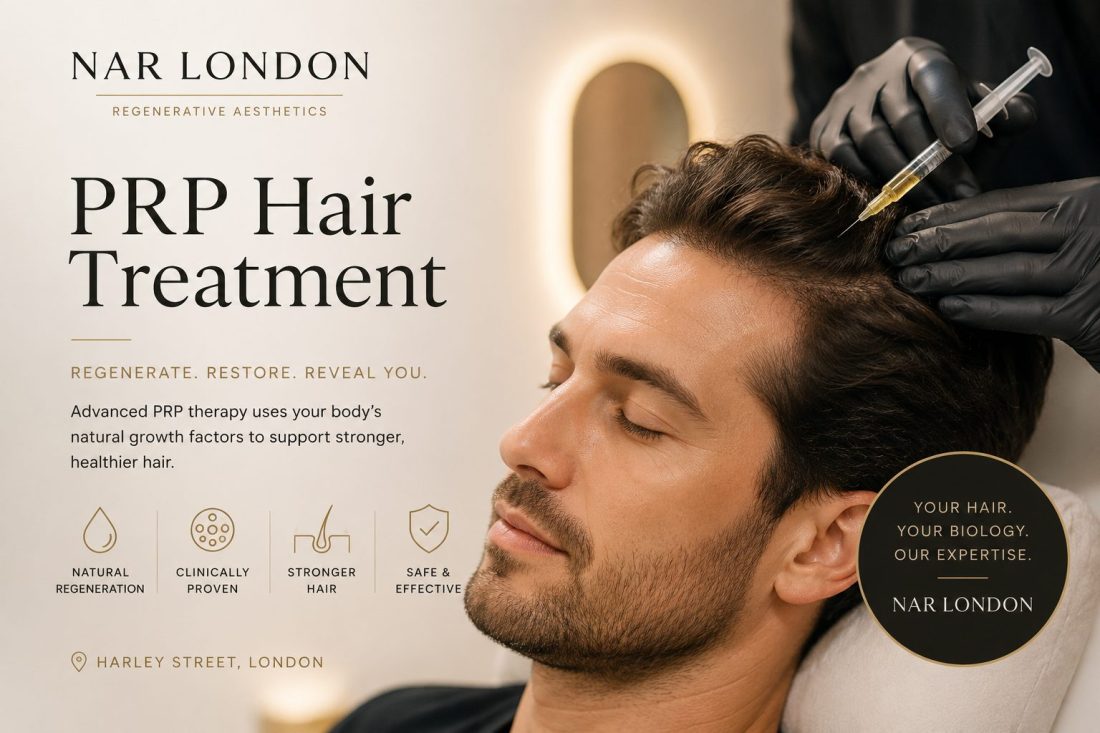
Best Clinic PRP Hair Restoration in London
Best Clinic for PRP Hair Treatment in London: What to Look For Before You Book
Hair loss has a peculiar way of changing how you see yourself.
At first, it may be a little more hair in the shower. A widening parting. A hairline that photographs differently. Perhaps your barber or hairdresser notices before you do.
Then you start looking for solutions.
And if you search for the best PRP hair treatment in London, you quickly discover another problem: almost every clinic appears to offer the same thing.
PRP. Your own blood. Growth factors. A centrifuge. A few injections into the scalp.
So why can the experience – and potentially the outcome – differ so much from one clinic to another?
Because PRP is not simply a product you buy. It is a biological treatment delivered through a protocol.
The diagnosis matters. The preparation matters. The treatment technique matters. The number and timing of sessions matter. And, perhaps most importantly, understanding why you are losing hair matters.
At NAR LONDON on Harley Street, our approach to PRP hair restoration begins there.
Not with:
“How many sessions can we sell you?”
But with:
“Why is your hair changing – and is PRP actually the right treatment for you?”
That distinction matters more than most people realise.
The short answer: what makes a good PRP hair clinic?
If you’re comparing PRP hair clinics in London, don’t choose on price or impressive before-and-after photographs alone.
Look for a clinic that:
- assesses the likely cause and pattern of your hair loss before treating it;
- explains honestly whether PRP is appropriate for your stage of hair loss;
- uses a considered and consistent PRP preparation and injection protocol;
- tracks your response over a course rather than treating each appointment in isolation;
- can investigate nutritional, hormonal or other health factors where relevant;
- offers other regenerative options when PRP isn’t the best answer;
- gives realistic expectations rather than promising miraculous regrowth.
That is the philosophy behind hair restoration at NAR LONDON.
What exactly is PRP hair treatment?
PRP stands for platelet-rich plasma.
A small amount of your own blood is collected and processed using centrifugation. This separates and concentrates a platelet-rich fraction of the plasma.
That preparation is then introduced into targeted areas of the scalp.
Platelets are best known for their role in clotting, but they also release biologically active signalling molecules and growth factors involved in tissue repair and cellular communication.
This is why PRP has attracted interest across regenerative medicine. NHS hospitals also use PRP in certain medical applications, although hair-loss treatment is generally provided privately.
For hair restoration, researchers are particularly interested in whether these platelet-derived signals can influence the environment surrounding follicles and help support follicles affected by progressive miniaturisation.
The important point is this:
PRP does not manufacture new hair follicles.
Its purpose is to support follicles that are still biologically capable of producing hair.
And that explains why timing matters.
Why early hair thinning can be the ideal time to consider PRP?
Imagine a hair follicle as a tiny factory.
With androgenetic – or pattern – hair loss, susceptible follicles gradually miniaturise. The hair produced can become progressively finer, shorter and less visible.
There is therefore an important difference between:
a weakened follicle
and
a follicle that is no longer capable of meaningful hair production.
PRP is generally much more interesting in the first situation.
This is why waiting until an area is completely bald before investigating regenerative treatment may reduce the possibilities available.
The NHS also makes an important point that many commercial hair-loss pages overlook: hair loss has multiple possible causes, including hereditary pattern loss, illness, stress, weight loss and iron deficiency, and it advises establishing the cause before approaching a commercial hair clinic.
We agree.
Does PRP for hair loss actually work?
This is where a good clinic should separate evidence from marketing.
PRP is not a guaranteed cure for hair loss.
But it is also no longer reasonable to dismiss it as simply an aesthetic trend.
A 2023 systematic review and meta-analysis examined nine randomised controlled trials involving 238 patients with androgenetic alopecia. PRP produced statistically significant improvements in hair density at three and six months compared with placebo. No serious adverse reactions were identified in the included trials.
Other systematic reviews have also reported favourable effects on hair density, while highlighting an important limitation in the literature: PRP protocols vary considerably between studies.
And that’s precisely why asking:
“Does PRP work?”
isn’t quite enough.
A better question is:
“Will PRP be useful for my type and stage of hair loss?”
That is the question we try to answer at NAR LONDON.
Not all hair loss is the same
This may be the most important section of this guide.
You can have two people sitting next to each other with apparently similar thinning hair – and potentially very different reasons for it.
Hair loss and excessive shedding can be associated with factors including:
Androgenetic alopecia
Commonly called male or female pattern hair loss, this involves genetically susceptible follicles progressively miniaturising.
This is one of the principal areas in which PRP has been studied.
Nutritional deficiencies
Iron status and other nutritional factors can matter to healthy hair production.
If a clinically relevant deficiency is contributing to shedding, simply injecting the scalp without addressing the underlying issue may be incomplete.
Hormonal and thyroid factors
Hair can be remarkably sensitive to physiological change.
Where the history suggests a possible hormonal or thyroid contribution, further investigation may be appropriate.
Stress, illness and physiological disruption
Significant stress, illness, rapid weight loss and other physiological events can trigger increased shedding.
Scalp conditions and other forms of alopecia
Not every form of alopecia should be treated as routine pattern hair loss.
Some presentations require medical or dermatological assessment.
This is why NAR LONDON doesn’t believe every person walking through the door with thinning hair should automatically receive PRP.
Sometimes the most valuable thing a practitioner can tell you is:
“PRP isn’t the first thing I would do here.”
Why NAR LONDON takes an integrative approach to hair loss?
This is one of the areas in which our philosophy differs from many conventional aesthetic clinics.
NAR LONDON combines regenerative aesthetics with integrative health.
That means we can look at hair loss from two directions:
What is happening at the follicle?
and
What might be happening within the person?
When appropriate, this may mean discussing relevant health history, nutrition, stress, hormonal factors or laboratory testing rather than treating the scalp as though it exists independently from the rest of the body.
Not everybody requires extensive testing.
Many people don’t.
But when the history suggests that something else deserves investigation, we believe it should be considered rather than ignored.
Because successful hair restoration begins with understanding the hair loss.
What makes PRP different from a drug?
One reason many patients are drawn to PRP is its autologous nature.
Autologous means the starting biological material comes from you.
We take your blood, process it and use the platelet-rich fraction as part of the treatment.
There is no donor plasma.
The appeal is therefore quite different from simply applying or taking another substance.
PRP belongs to a broader idea that increasingly defines NAR LONDON: Regenerative aesthetics
Rather than trying to disguise every sign of change, regenerative treatments aim to work with biological processes involved in repair and tissue quality.
For hair, that means supporting the follicular environment rather than cosmetically concealing thinning.
Your biology becomes part of the treatment.
What happens during PRP hair treatment at NAR LONDON?
1. Consultation
We begin by discussing your hair-loss history.
When did it start?
Has it progressed slowly or suddenly?
Is the loss concentrated around the temples, crown or parting?
Is it diffuse?
Are you shedding significantly?
Have you tried other treatments?
Has anything changed in your health, diet, medication, stress levels or hormones?
These questions matter.
2. Assessment
We assess the pattern and extent of thinning and whether PRP is a reasonable option.
If your presentation suggests that another underlying factor needs investigation, we discuss that with you.
3. Blood collection
A small blood sample is taken.
4. PRP preparation
The sample is processed using centrifugation to separate the platelet-rich plasma from other components of the blood.
5. Scalp treatment
The prepared PRP is delivered strategically to the areas where follicular support is required.
6. Treatment programme
Hair biology works in cycles.
PRP is therefore generally approached as a course rather than an isolated event.
At NAR LONDON, a typical initial programme may involve approximately three treatments spaced around four to six weeks apart, with the exact protocol adapted to the individual.
Maintenance may subsequently be considered according to response and progression.
When will I see results from PRP hair treatment?
Not overnight- there is no magic treatment.
And any clinic suggesting otherwise should make you cautious.
Hair growth is slow and follows the natural hair cycle.
PRP is not like colouring your hair or adding extensions, where the visual change is immediate.
The earliest thing some patients notice is a change in shedding.
Visible improvements in density or hair quality, where they occur, require time because the follicle must progress through the hair-growth cycle.
Think in months, not days.
This slower progression is also why photographs taken under consistent conditions can be useful for monitoring change.
Can PRP regrow a completely bald area?
Usually, this is where expectations need to be particularly realistic.
PRP is designed to support existing viable follicles.
It should not be presented as a treatment capable of recreating follicles that have been permanently lost.
Where an area has advanced baldness with insufficient viable follicles, surgical hair transplantation may be the more appropriate discussion.
At NAR LONDON, regenerative hair treatment and hair transplantation are not viewed as competing philosophies.
They solve different problems.
For the right patient, regenerative treatments can also form part of a wider strategy around transplantation.
PRP vs PRF vs Autologous Exosomes: which is best for hair?
This is another reason choosing a clinic with more than one regenerative option can be useful.
NAR LONDON offers a spectrum of regenerative hair treatments rather than trying to make every patient fit a single treatment.
PRP: Platelet-Rich Plasma
The established starting point for many people with early-to-moderate thinning.
It uses platelet-rich plasma prepared from your own blood and has a growing clinical evidence base for androgenetic alopecia.
PRF: Platelet-Rich Fibrin
PRF is another autologous platelet-based preparation.
Its preparation differs from conventional PRP and incorporates a fibrin matrix.
It isn’t automatically “better PRP”.
It is a different biological preparation that may be considered according to the treatment strategy.
Autologous Exosomes
This takes the regenerative conversation further into cell-to-cell signalling.
Extracellular vesicles, including exosomes, are microscopic structures involved in communication between cells.
Their role in regenerative medicine and hair biology is an exciting area of research, but the evidence base is less mature than for established treatments, and claims should therefore remain proportionate to the science.
At NAR LONDON, the question is not:
“Which treatment sounds newest?”
It is:
“Which regenerative approach makes sense for this patient?”
Can PRP be combined with other hair-loss treatments?
Potentially, yes.
Hair loss is rarely a competition in which only one treatment is allowed to win.
Depending on the individual, a wider strategy may involve PRP alongside other established approaches.
For example, the NHS identifies minoxidil and finasteride as principal treatments for male pattern baldness, with minoxidil also used for female pattern hair loss; these medicines are not suitable for everyone and require appropriate consideration.
Research has also explored PRP in combination with other therapies.
At NAR LONDON, regenerative options may also include PRF, hair mesotherapy and autologous exosome-based approaches depending on suitability.
The goal isn’t to throw everything at your scalp.
It is to create a rational treatment strategy.
Is PRP hair treatment safe?
Because PRP is prepared from the patient’s own blood, it avoids some of the concerns associated with donor-derived material.
However, autologous does not mean risk-free.
Temporary effects associated with scalp injections can include tenderness, redness, swelling, pinpoint bleeding, bruising or headache.
Infection is possible whenever the skin is penetrated, although appropriate clinical technique is intended to minimise this risk.
Systematic reviews of PRP for androgenetic alopecia have generally reported a favourable safety profile, with no serious treatment-related adverse events identified in several analyses.
Your medical history and suitability should still be assessed before treatment.
Men and women can experience hair loss very differently
PRP hair treatment for men
Men commonly notice recession around the temples, changes to the frontal hairline or thinning at the crown.
The instinct is often to wait.
That can be a mistake.
Regenerative treatments depend on there being follicles worth supporting, so earlier assessment can give you more options.
PRP hair treatment for women
Female hair loss is often more diffuse.
A widening parting or reduction in overall density may be more noticeable than a receding hairline.
Women can also experience shedding associated with physiological, nutritional or hormonal changes.
For that reason, simply labelling every female patient as having “genetic hair loss” without taking a broader history can miss important information.
Seven questions to ask before choosing a PRP hair clinic in London
This is the checklist we would use ourselves.
1. Will you assess why I’m losing hair before treating me?
If the answer is essentially “PRP works for everyone”, keep looking.
2. Who will actually perform my treatment?
You should know who is treating you and their relevant training and experience.
3. How is your PRP prepared?
“PRP” is not one universally identical preparation. Centrifugation, platelet concentration, blood components and treatment protocols vary.
4. How many sessions are you recommending – and why?
A recommendation should have a rationale.
5. How will you assess whether I’m responding?
Hair restoration should involve review, not simply repeating appointments indefinitely.
6. What happens if PRP isn’t right for me?
A trustworthy clinic should be prepared to recommend another route — or no treatment at all.
7. Are you promising results?
If so, be cautious.
Biology doesn’t come with guarantees.
So, what is the best PRP hair clinic in London?
There is no objective league table that can truthfully crown one clinic “the best PRP clinic in London” for every patient.
And we aren’t going to invent one.
What we can tell you is what we believe excellent hair restoration should look like.
It should be:
diagnosis-led rather than sales-led;
biologically informed rather than protocol-by-numbers;
personalised rather than one-size-fits-all;
and
honest enough to tell you when PRP isn’t the answer.
That is the standard we aim for at NAR LONDON.
Why choose NAR LONDON for PRP Hair Treatment?
NAR LONDON is a specialist clinic at 15 Harley Street, London W1G 9QQ, currently rated 4.9/5 from 60 Google reviews in the local-business data available to us.
But location and ratings are not the main reason we believe patients should consider us.
Our difference is the way we think about hair.
Regenerative hair expertise
PRP is part of a broader regenerative programme that includes PRF and advanced autologous approaches.
Hair + health
Our integrative-health background means we can consider the wider biological picture where appropriate rather than looking exclusively at the scalp.
Continuity
Hair restoration is a journey measured over months. Consistent assessment and continuity of care matter.
Harley Street, without the factory model
NAR LONDON is a boutique clinic rather than a high-volume hair-loss chain.
We deliberately keep the experience personal.
Honest treatment selection
Sometimes PRP is the right answer.
Sometimes another regenerative treatment makes more sense.
Sometimes further investigation should come first.
And sometimes a hair transplant is the more realistic option.
We would rather tell you that than sell you the wrong treatment.
The best time to treat hair loss is before everybody else notices it
You don’t need to wait until hair loss becomes obvious. Time is of the essence with hair thinning and hair loss.
In fact, biologically, waiting can work against you.
If your ponytail feels thinner, your parting looks wider, your crown is beginning to show, your hairline has started moving backwards or you’re simply shedding more than you used to, an assessment can help establish what is happening.
You may need treatment.
You may need investigation.
You may simply need reassurance.
But you should know which.
Start with your hair. Look deeper at the cause.
If you are considering PRP hair treatment in London, book a hair consultation at NAR LONDON on Harley Street.
We’ll assess your hair loss, discuss what may be contributing to it and explain whether PRP – or another approach – makes sense for you.
No miracle promises.
No one-size-fits-all package.
Just a more intelligent approach to keeping the hair you have — and helping viable follicles perform at their best.
Explore PRP Hair Treatment at NAR LONDON
NAR LONDON
15 Harley Street
London W1G 9QQ
Regenerate. Restore. Reveal You.
FAQs
What is PRP hair treatment?
PRP hair treatment uses platelet-rich plasma prepared from a sample of your own blood. The platelet-rich preparation is introduced into targeted areas of the scalp as a regenerative treatment for appropriate forms of hair thinning.
Does PRP work for hair loss?
Clinical trials and systematic reviews suggest PRP can improve hair density in some patients with androgenetic alopecia, although results and treatment protocols vary. It should not be presented as guaranteed hair regrowth.
Who is a good candidate for PRP hair treatment?
PRP is generally most interesting where thinning follicles remain viable, particularly in pattern hair loss. Suitability depends on the cause, extent and duration of hair loss and individual health factors.
How many PRP sessions do I need for hair loss?
Treatment is usually performed as a course rather than a single session. At NAR LONDON, an initial programme commonly involves around three treatments approximately four to six weeks apart, followed by assessment and maintenance where appropriate.
How quickly does PRP regrow hair?
Hair growth is slow. Changes should be assessed over months rather than days or weeks. Published clinical studies commonly evaluate outcomes at around three and six months.
Can PRP restore a completely bald scalp?
PRP cannot be relied upon to recreate follicles that are no longer viable. It is better thought of as a treatment designed to support existing follicles. Advanced hair loss may require a different strategy, including consideration of transplantation.
Is PRP suitable for women?
Potentially. PRP has been investigated for pattern hair loss in both men and women. Female hair loss can have several causes, however, so assessment is important before treatment. (PubMed)
Is PRP better than minoxidil?
They are different treatments and the appropriate choice depends on the patient. Minoxidil is an established treatment for pattern hair loss; PRP is an autologous injectable regenerative treatment. They may sometimes form part of the same overall strategy.
What is the difference between PRP and PRF for hair?
Both are prepared from the patient’s blood, but their processing and biological composition differ. PRF incorporates a fibrin matrix and should be considered a different platelet preparation rather than simply “stronger PRP”.
Is PRP hair treatment permanent?
Hair loss can be progressive. Even when PRP produces improvement, maintenance may be recommended according to the underlying condition and individual response.
Where is NAR LONDON located?
NAR LONDON is at 15 Harley Street, London W1G 9QQ, in London’s prestigious medical district.