


Regenerative aesthetic skin Treatments London
The Rise Of Regenerative Aesthetics
Beauty has traditionally been approached from the outside.
A line appears, so we soften it.
Volume is lost, so we replace it.
Skin looks tired, so we try to make it look brighter.
But what if the more interesting question is not simply what do we see?
What if it is:
What is happening underneath?
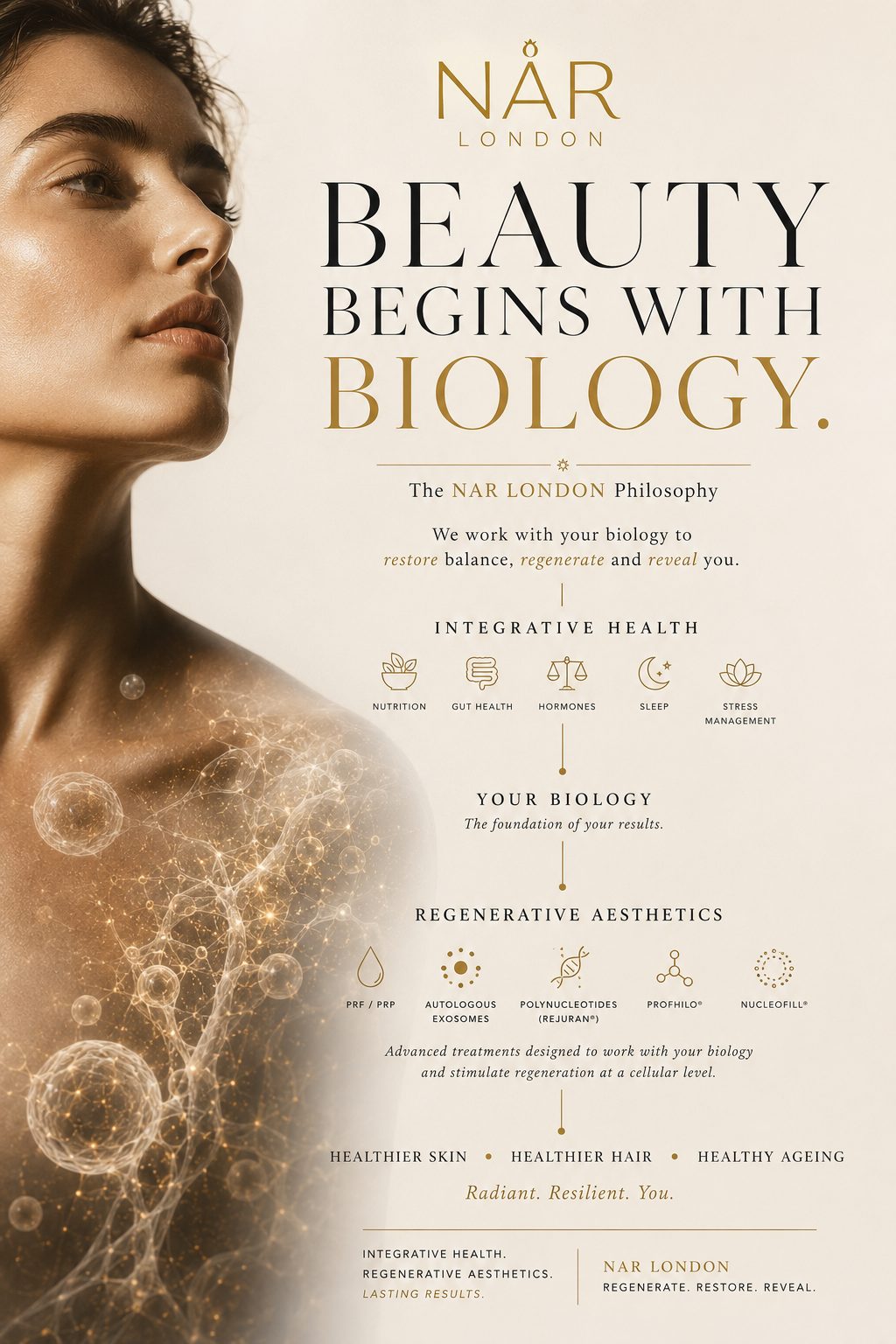
This idea sits at the heart of our approach to regenerative aesthetics and integrative health.
We believe that healthy-looking skin, stronger hair and graceful ageing are closely connected to biology.
Because skin is not simply a surface.
It is living tissue.
And increasingly, modern aesthetic medicine is beginning to look beyond correction towards something more sophisticated: supporting the biological environment in which healthier-looking tissue can exist.
Beauty Is More Than What We See
Skin is an extraordinarily complex organ.
Beneath its visible surface is a constantly changing biological environment involving fibroblasts, collagen and elastin, blood vessels, immune cells, extracellular matrix, signalling molecules and many other structures working together.
With time, this environment changes.
Research into skin ageing increasingly highlights several interconnected processes, including cellular senescence, chronic low-grade inflammation, oxidative stress, changes to the extracellular matrix and altered communication between cells.
Collagen itself is not simply a cosmetic buzzword. It is one of the fundamental structural components of skin, and its organisation and turnover change throughout life.
This helps explain why ageing is much more complicated than the appearance of a wrinkle.
A wrinkle is something we see.
The biology beneath it is the more interesting story.
From Correction to Regeneration
Traditional aesthetic medicine has often focused on correction.
Regenerative aesthetics asks a slightly different question:
Can we improve the quality of the tissue itself?
This does not mean that every treatment labelled “regenerative” genuinely regenerates tissue. The science is more nuanced than that.
A recent review proposed that true regeneration in aesthetic medicine should be judged by biological mechanism, functional tissue integration and durability—not simply by a temporary visual change.
That distinction matters.
Our philosophy is therefore not about chasing trends or dramatically changing someone’s appearance.
It is about selecting treatments designed to work with the patient’s biology, while remaining realistic about what the scientific evidence can and cannot currently demonstrate.
The aim is not to look different. The aim is to look healthier, fresher and still recognisably you.
That is what regenerative aesthetics means to us.
Your Biology Is the Foundation
No two people age in exactly the same way.
Genetics matter.
But so do environmental exposure, hormones, nutrition, sleep, stress, inflammation, lifestyle and the cumulative effects of time.
Scientists increasingly use the concept of the exposome to describe the many external and internal influences that interact with our biology throughout life.
This is why we do not believe aesthetic medicine should always be viewed in isolation.
Someone concerned about dull skin may simply need an aesthetic treatment.
But persistent changes in skin or hair can sometimes exist alongside wider factors involving nutrition, hormones, stress or general health.
That does not mean every aesthetic concern requires extensive testing.
It means that sometimes it is useful to ask a better question:
Why is this happening?
Integrative Health + Regenerative Aesthetics
This is where the NAR LONDON philosophy becomes different.
We bring together two complementary disciplines.
Integrative Health
Where appropriate, this can involve looking at factors such as:
Nutrition • Gut Health • Hormones • Hydration • Sleep • Stress • Lifestyle
The purpose is not to promise that optimising one of these factors will reverse ageing.
Rather, it recognises something fundamental:
the skin and hair belong to the same biological system as the rest of you.
Regenerative Aesthetics
Alongside this, regenerative and bioregenerative aesthetic treatments can be selected according to the tissue, concern and individual.
Depending on the individual, treatment options may include:
PRP • PRF • Autologous Exosomes • Polynucleotides • Rejuran® • NucleoFill® • Profhilo® • Mesotherapy
These treatments do not all work in the same way, and they should not be grouped together as though the evidence for each were identical.
For example, platelet concentrates such as PRP contain platelets and bioactive signalling molecules involved in tissue repair. Clinical research into PRP for facial rejuvenation has reported potential improvements in parameters including texture, wrinkles, hydration and dermal characteristics, although systematic reviews also emphasise considerable variation in protocols and the overall quality of evidence.
For newer biological approaches – including polynucleotides and extracellular-vesicle-based strategies – the biological rationale is promising, while clinical evidence remains comparatively heterogeneous and continues to evolve.
That distinction is important to us.
Regenerative medicine should be evidence-led, not hype-led.
The Skin Has Its Own Regenerative Intelligence
One of the most fascinating developments in aesthetic science is our growing understanding of the skin microenvironment.
Cells do not operate independently.
They communicate.
Fibroblasts interact with the extracellular matrix. Immune cells influence inflammation. Blood vessels provide nutrients and oxygen. Signalling molecules coordinate repair. Different layers of the skin communicate with one another.
Ageing can gradually disrupt this environment.
Researchers now describe skin ageing as involving a network of interconnected changes rather than the failure of one individual structure.
This changes how we can think about aesthetic medicine.
Instead of asking only:
“How can we hide the signs of ageing?”
we can also ask:
“How can we support healthier tissue function and quality?”
That is a much more interesting question.
What Does “Beauty Begins With Biology” Actually Mean?
For us, it means six things.
Work with the body, not against it.
Where appropriate, favour approaches that support or stimulate biological processes rather than simply creating an artificial-looking change.
Improve quality before chasing perfection.
Hydration, texture, elasticity, resilience and overall tissue quality matter.
Look beyond the surface when necessary.
Skin and hair can sometimes reflect broader biological influences.
Preserve individuality.
A successful treatment should not erase the characteristics that make someone recognisable.
Use science without overselling it.
Regenerative aesthetics is evolving rapidly. Some treatments have stronger clinical evidence than others, and responsible practice means acknowledging that.
Think long term.
The objective is not simply what someone looks like immediately after treatment, but how we can support healthier-looking skin and hair over time.
Healthy Skin. Healthy Hair. Healthier You.
Perhaps the future of aesthetic medicine will not be defined by doing more.
It may be defined by understanding more.
Understanding how skin ages.
Understanding how cells communicate.
Understanding why collagen architecture changes.
Understanding the relationship between tissue quality and the biological environment surrounding it.
And understanding that the most sophisticated aesthetic result may be one that nobody can immediately identify as a treatment.
You simply look well.
Rested.
Healthy.
Like yourself.
That is the philosophy behind NAR LONDON.
Beauty Begins With Biology.
Regenerate. Restore. Reveal You.
Discover the NAR LONDON Approach
NAR LONDON brings together regenerative aesthetics and integrative health from Harley Street, with treatment plans tailored to the individual rather than a one-size-fits-all approach.
Whether the concern is skin quality, under-eye rejuvenation, hair health or healthy ageing, the starting point is the same:
understand the individual first, then choose the treatment.
Explore Regenerative Aesthetics | Explore Integrative Health | Book a Consultation